
“I am one of the people who love the why of things.”
About
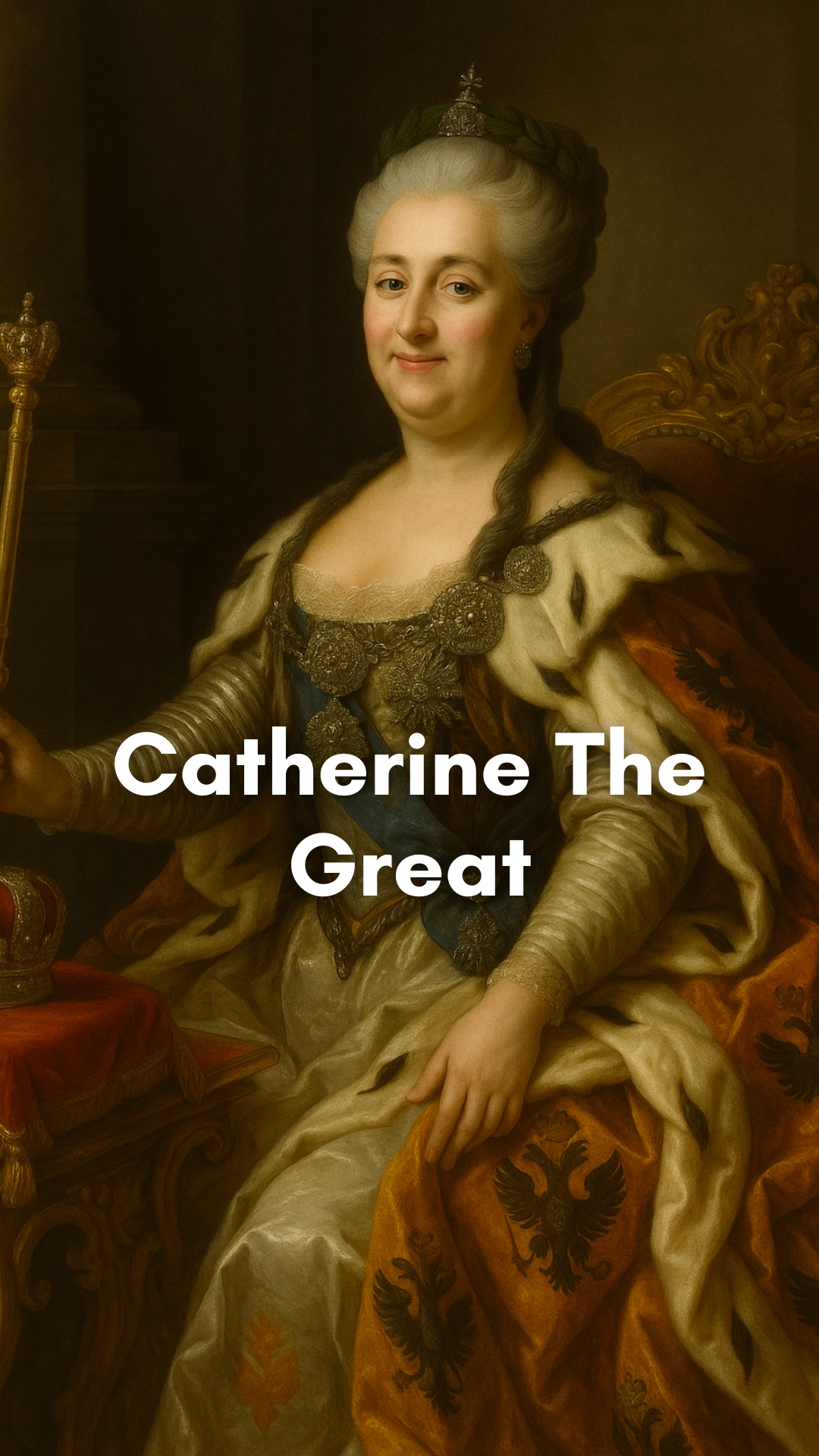
Born a princess, she became an empress, not by birthright, but by brilliance. Catherine ruled with a pen in one hand and a scepter in the other, blending Enlightenment ideals with imperial ambition. She devoured books, debated philosophers, and expanded borders with strategic fire. Under her, Russia didn’t just grow, it awakened. She reimagined power not as domination, but as an art: a balance of reason, reform, and resolve. Driven by a love for the “why” of things, Catherine proved that intellect could command a throne, and that curiosity… when sharpened by courage, could reshape a continent.
Place of Birth
Stettin, Prussia (now Szczecin, Poland)
Birthday
May 2, 1729
Death
November 17, 1796 in Saint Petersburg, Russian Empire
Legacy
Catherine the Great was Empress of Russia from 1762 until 1796, and she remains one of the most powerful and accomplished female rulers in world history. Her reign expanded Russian territory, strengthened central authority, and brought Enlightenment thinking to the empire. Under her leadership, Russia emerged as a major European power, both militarily and culturally, and her influence helped usher in a golden age for the Russian aristocracy and intelligentsia.

Influence
Catherine’s influence extended across politics, philosophy, literature, and education. She corresponded with Enlightenment thinkers like Voltaire, Diderot, and Montesquieu and sought to implement their ideas while maintaining autocratic control. She championed the arts, founded schools and libraries, reformed governance, and laid the groundwork for Russia’s 19th-century intellectual and cultural explosion.

Values & Beliefs
Catherine valued knowledge, reason, order, and power. As an enlightened absolutist, she believed in progressive reform guided by a strong ruler. She promoted education, secularization, and legal codification, while also maintaining control over the nobility and Orthodox Church. Her reign blended ambition with idealism, marked by a deep curiosity and a pragmatic approach to leadership.
Most Famous For:
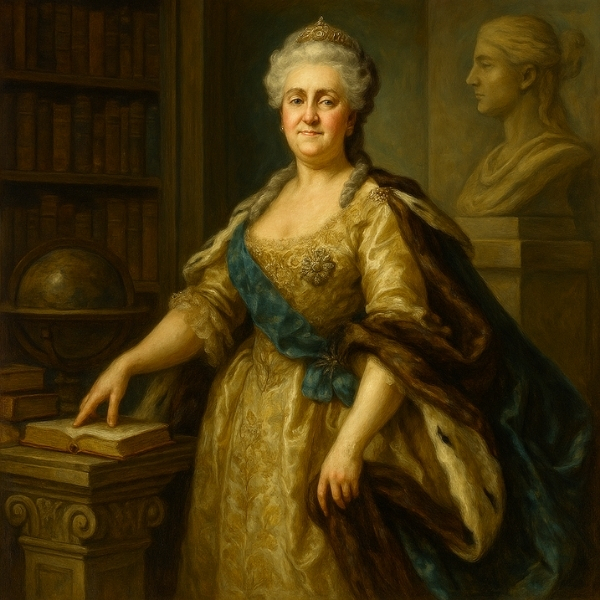
Expanding and strengthening the Russian Empire through war, diplomacy, and reform
Bringing Enlightenment ideas to Russia while preserving autocracy
Supporting arts, science, literature, and philosophy across Europe
Reforming education, government, and law with long-lasting impact
“A great wind is blowing, and that gives you either imagination or a headache.”
 Ethan Townzen