
“Let us choose for ourselves our path in life, and let us try to strew that path with flowers.”

About
In a world that told her no, Émilie answered with brilliance. Draped in silks and armed with science, she rewrote the laws of motion and shattered the myth that reason belonged only to men. Translating Newton with a mind sharper than any court intrigue, she bridged the cosmos and the salon, proving that intellect and elegance could share the same stage. She lived for discovery, for joy, for the freedom to think and dared to declare that women, too, could shape the stars. In every equation and every flower she placed along her path, Émilie left a legacy of light.
Place of Birth
Paris, France
Birthday
December 17, 1706
Death
September 10, 1749 (Lunéville, France)
Legacy
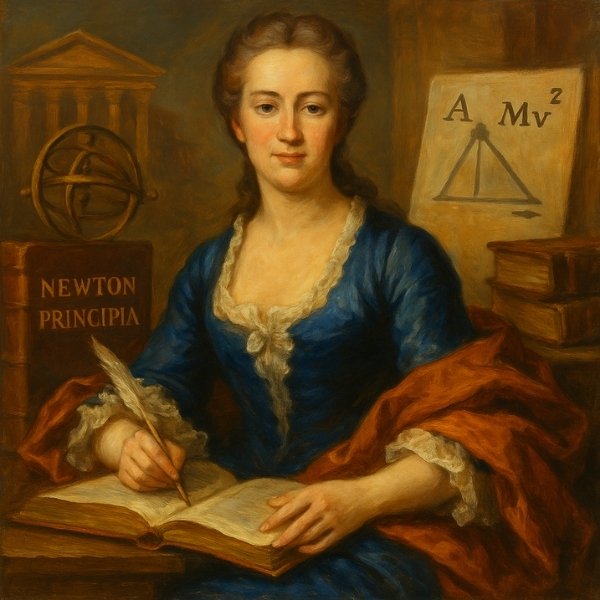
Émilie du Châtelet’s legacy lies in her vital contribution to making Newtonian physics accessible to continental Europe. Her French translation of Principia, still in use today, clarified Newton’s laws and introduced key concepts of energy conservation and motion. Her work helped bridge the gap between Newtonian mechanics and the Enlightenment’s philosophical pursuits, proving that women could lead in both science and reason. She helped lay the groundwork for modern physics and inspired future generations of female scientists.
Influence
Châtelet’s influence extends across science, feminism, and intellectual history. She challenged the prevailing belief that women lacked the capacity for higher reasoning and scientific thought. Her achievements influenced the likes of Voltaire, who openly credited her genius, and her philosophical writings prefigured many ideas about women’s rights and education. She has become a symbol of resilience, brilliance, and unapologetic ambition.

Values & Beliefs
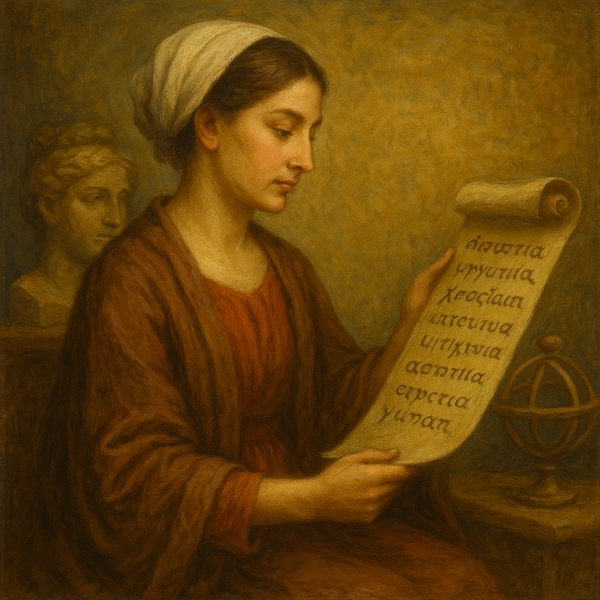
Émilie valued reason, independence, and intellectual freedom. She believed in the pursuit of truth through science and advocated for the education of women, arguing that women’s minds were equal to men’s. A philosopher of joy as well as logic, she balanced analytical rigor with a celebration of love, beauty, and personal choice. She lived with fearless conviction, guided by curiosity and a refusal to conform.
Most Famous For:
Her translation and commentary on Newton’s Principia Mathematica
Advancing the concept of energy conservation before it was formally established
Partnering intellectually with Voltaire, with whom she conducted experiments
Writing Foundations of Physics (Institutions de Physique), a major philosophical-scientific work
Advocating for women’s education and intellectual equality
“Judge me for my reason, not for my gender.”
 Ethan Townzen