
“Attention is the rarest and purest form of generosity.”

About
Simone Weil was a French philosopher, mystic, and political activist whose short but impactful life left a profound legacy in the realms of ethics, spirituality, and social justice. A brilliant student and thinker, she taught philosophy, worked in factories to better understand working-class conditions, and joined the French Resistance during World War II. Her life was marked by radical empathy, intense moral seriousness, and deep spiritual reflection.
Place of Birth
Paris, France
Birthday
February 3, 1909
Death
August 24, 1943 (Ashford, United Kingdom)
Legacy
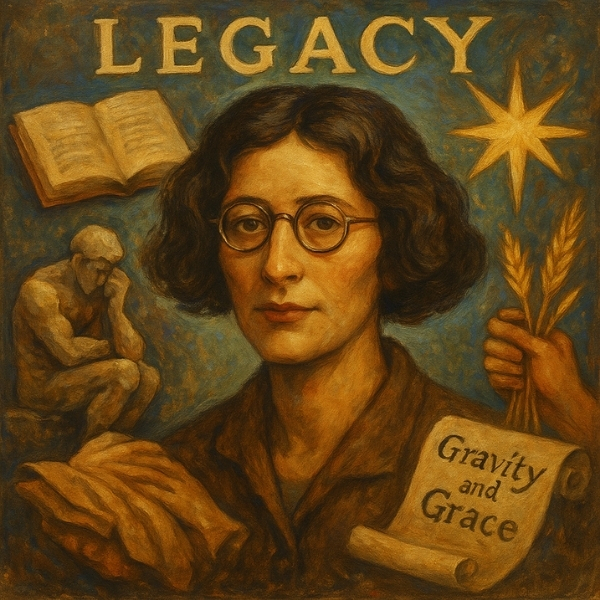
Weil’s legacy is one of intellectual courage and spiritual depth. Though she died at just 34, her posthumously published writings, including Gravity and Grace, The Need for Roots, and Waiting for God… shaped postwar philosophy and theology. She offered a rare blend of social critique and mystical insight, challenging readers to confront suffering, injustice, and the demands of love and attention. She is revered today by thinkers across disciplines for her uncompromising search for truth.
Influence
Simone Weil influenced philosophers, theologians, poets, and political theorists worldwide. Her ability to weave together Christian mysticism, Greek philosophy, and Marxist social critique created a unique and enduring voice. Figures such as Albert Camus, Iris Murdoch, and Pope Paul VI praised her contributions. She continues to inspire those drawn to contemplative ethics, nonviolence, and spiritual activism.

Values & Beliefs
Weil valued attention, humility, truth, and justice. She believed in confronting suffering, not fleeing from it, and that the soul grows through affliction and compassion. Her worldview was rooted in self-denial and radical empathy, believing that real love means seeing others as they are, without distortion or desire. Though drawn to Christianity, she refused baptism out of solidarity with the oppressed, placing action and presence above religious labels.

Most Famous For:
Writing philosophical and mystical works such as Gravity and Grace and The Need for Roots
Advocating for the rights of the working class through both writing and manual labor
Merging Christian mysticism, ancient philosophy, and political thought
Inspiring generations of ethicists, theologians, and activists
Being one of the 20th century’s most original and morally serious thinkers
“The soul is not a thing to be saved, but a place where truth is born.”
 Ethan Townzen